Spec, Stay Alive!
AI-driven workflows have changed what happens after a team picks the right problem. As a product manager, my job on the front end looks familiar: I’m still the voice of the user, problems still get prioritized against team goals and hypotheses backed by data. What’s changed is everything that happens next.
Focus blocks used to go to compiling extensive documentation before kickoff. Now they go to strategic thinking, reviewing code, and sharing ideas in our creatively named Slack channel, #ideas. Engineering, Product, and Design show up to kickoff with concepts they’ve already prototyped, mapped out, or broken down. Then we experiment: dogfooding early releases, embedding feedback loops faster and more frequently than ever. Agents handle the polish work that used to push a release back a sprint. Check-ins and pivots happen in PR reviews, not bi-weeklies.
And this is happening across multiple projects at once. #productmaxxing
Here’s the problem: the faster your team iterates, the faster your context fragments. The hypothesis you started with at kickoff drifts from the actual work landing in the Epic, which is moving faster than you can track. Decisions made in PR comments and quickly added Stories never make it back to the spec. You re-share the same context across tools, across threads, across teammates and agents, and you lose confidence that decisions are actually landing in the work being built.
This is where Korey Projects comes in. Cue “ta-da!” sound effect.
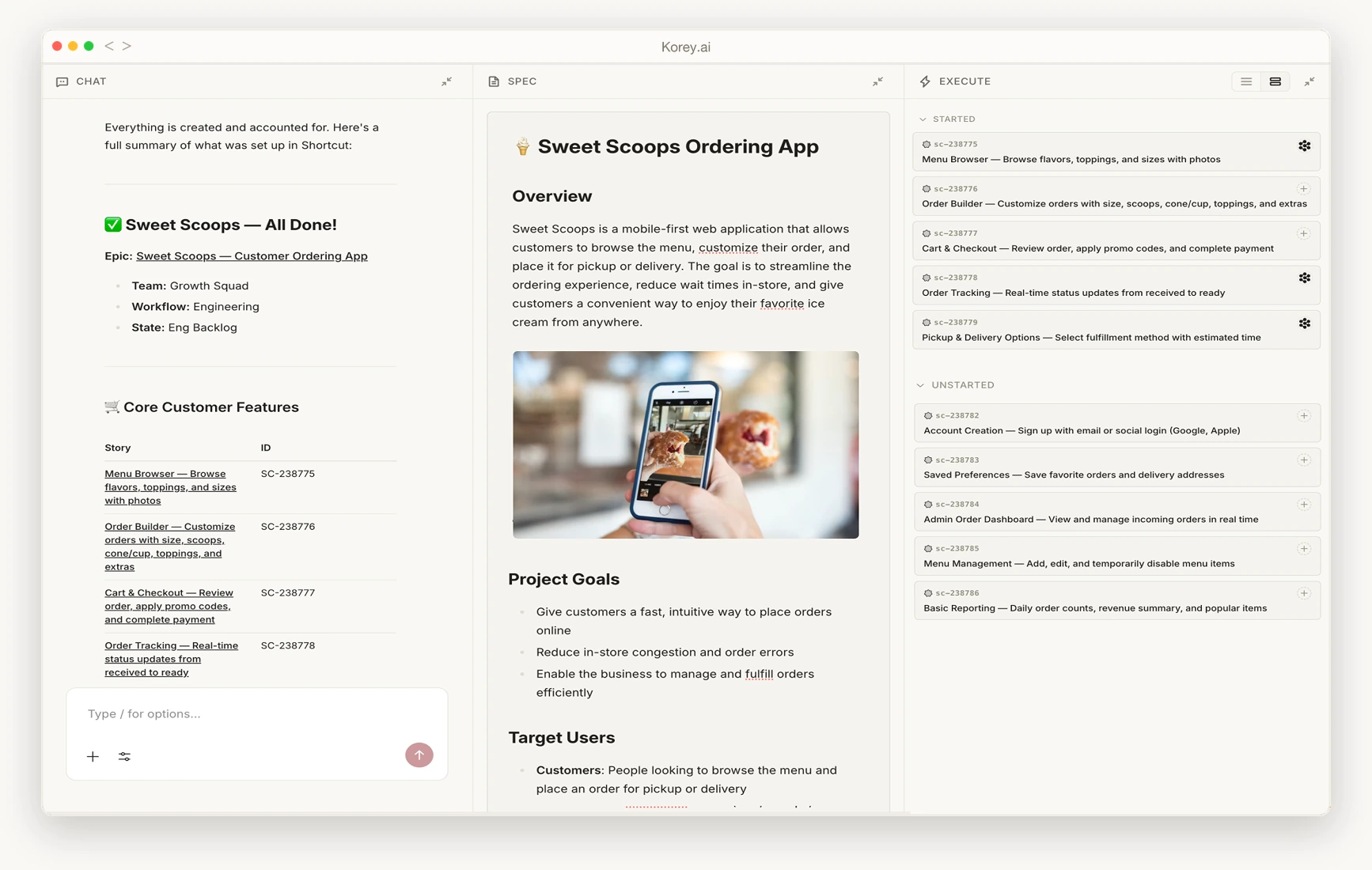
A Korey Project starts with your spec and keeps it alive through handoff. In one view: your editable spec, a chat with Korey, and the actual work: Stories and tasks broken down from the spec and handed off to agents you can manage in real time. Refine the problem, update the spec in context or through chat, and watch that flow into execution.
If your team runs on Shortcut, Jira, or GitHub Issues, the connection is direct. Work created in a project lands in your workspace as real Stories, statuses stay in sync, and Korey surfaces things your PM tool alone doesn’t, like which stories have an agent actively working them or a PR waiting on you. No more reconstructing statuses from tabs, filtered views, terminal windows, and three different desktop apps. It lives in one place, and the spec stays the source of truth from problem to shipped solution.
Korey Projects is currently in closed beta. If you’d like access to see what we’re building, connect with our team at support@korey.ai and tell us what you think: what works, what’s missing, and what you’d want a Project to do next. Not to worry… your feedback won’t sit in a backlog. We’ll be looping on your input in a Korey Project.